The story of the secret century-old deal which aimed to carve up the Middle East in ways that still reverberate today.
It is 50 minutes long and includes many of the top historians of WWI
discussing the making of the Sykes-Picot Agreement and the Sharif
Hussein - Henry MacMahon Correspondence
How an agreement signed in 1916 became shorthand for western
treachery, greed and the impact of colonial machinations on the lives of
local peoples.
One of the most striking observations, when comparing a map of Europe
with one of the Middle East or North Africa, is how different they are.
The borders of most European nation states are wonderfully convoluted,
following organically ‘natural’ contours designated by geography,
ethnicity, language, religion or culture. The borders of Middle Eastern
or North African nations, by stark contrast, look positively artificial.
Straight lines abound, with parallels, perpendiculars and even right
angles all glaringly conspicuous, even to the casual observer. It is
almost as if someone had taken a pencil and ruler and arbitrarily
decided on the shape and placement of their garden allotment, rather
than engage in the serious business of demarcating colonial borders that
would inevitably impact the lives of the millions of inhabitants
unfortunate enough to reside there.
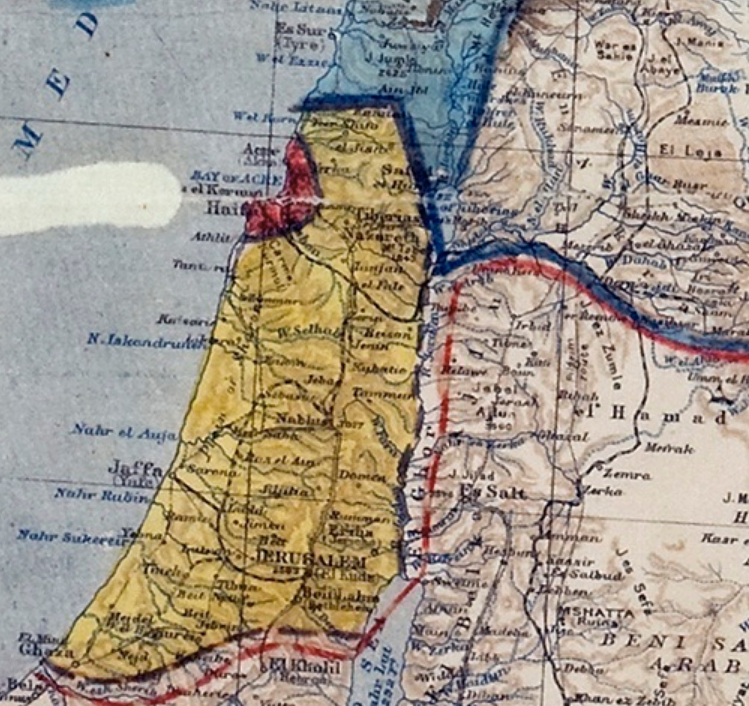
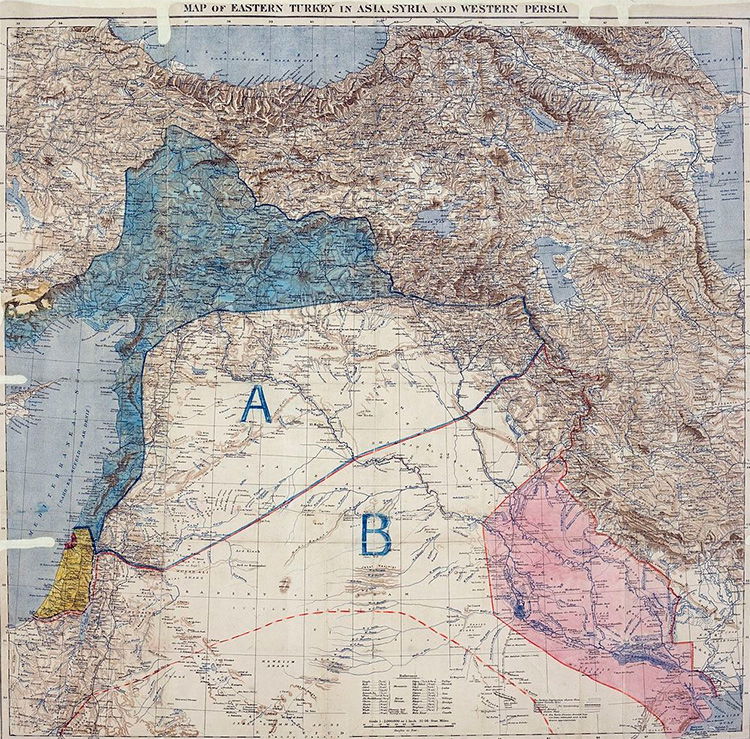
Map of the Sykes-Picot Agreement Map of the Sykes-Picot Agreement (Click to enlarge map)
May 16th 2016 is the 100th anniversary of one particularly notorious
example of this colonial practice. In 1916, in the midst of the First
World War, the French and British empires, greedily eyeing their spoils
of war in the shape of the crumbling Ottoman Empire, signed the secret
Sykes-Picot agreement.
The attitude of Sir Mark Sykes, an ill-informed British diplomat,
tells us a great deal about the capricious and callous nature of
colonial rule at the time. When asked by the British Foreign Secretary
what sort of boundary agreement he would like to have with the French,
Sykes declared:
I should like to draw a line from the ‘e’ in Acre to the last ‘k’ in Kirkuk.
Ponder upon the absurd arbitrariness of that statement for a second.
It would almost be comical were it not for the seriousness of its
consequences. This arbitrary line in the sand, based on a cartographer’s
typesetting on a colonial map, established the boundaries between the
British and French spheres. The French would claim everything to the
north of the line and the British to the South. Following the war, this
bizarre line in the sand would go on to become the border between Iraq,
Syria and Jordan and laid the foundation for demarcating the borders of
these new artificial states in subsequent treaties, such as those signed
during and after the San Remo Conference in 1920.
In doing so, the new artificial borders painfully split existing
communities in some places, while in others, they casually shoehorned
together distinct groups, previously separated along religious, ethnic
and linguistic lines, to now live cheek by jowl in strange new political
unions. Of course, as Benedict Anderson stated, all nations are
imagined communities in some sense and, as Ernest Renan argued, getting
one’s history wrong is part of being a nation. In the case of Europe,
however, nations often had the choice and desire to create these
contrived political identities or, at the very least, the time to
contest, negotiate and ultimately reconcile themselves to these
manufactured borders and identities, over the course of many decades, if
not centuries.
Not so for the case of Iraq, where a bankrupt postwar Britain,
attempting to do empire on a budget, artificially cobbled together an
administratively expedient new political entity, from parts of three
distinct Ottoman provinces: the Northern Sunni Kurdish areas; the
central Sunni Arab areas around Baghdad; and the Southern Shiite Arab
areas around Basra. The inherent volatility of this political chimera
allowed the British Empire to deploy its infamous ‘divide and rule’
strategy, promoting religious and ethnic differences, while
simultaneously playing off various communities against one another, in
order to prevent them from becoming too powerful.
Mark Sykes (left) and François Georges-PicotMark Sykes (left) and François Georges-Picot
What makes the Sykes-Picot Agreement all the more contemptible, is
that it was agreed clandestinely, precisely because the British had
already decided on the outcome for some of these territories when they
pledged to support the establishment of an Arab state over all of the
territory to the West and South of Iraq. This had not been a sign of
British magnanimity, largesse or support for Wilsonian aspirations of
self-determination, but rather, shrewd realpolitik. King Hussein bin
Ali, the Sharif of Mecca was promised the future Arab state in return
for rising up against the Ottoman Turks in the Arab Revolt, which T.E.
Lawrence had helped to organise. As many readers familiar with David
Lean’s 1962 film, Lawrence of Arabia, will be aware, the Arabs lived up
to their side of the bargain, fighting valiantly and managing to secure
key victories for the Allies at places like the port city of Aqaba and
even helped to capture Jerusalem itself.
As if betrayal of their loyal Arab allies was not enough, the British
further compounded their duplicity the following year with the Balfour
declaration of 1917. Here the British pledged to also support the
establishment of a Jewish national home in Palestine, in efforts to
secure the support of world Jewry.
So by this stage, the British had now promised roughly the same
territory to both Arabs and Jews, while simultaneously double-crossing
both parties, by secretly dividing up the land between the French and
themselves.
Rather awkwardly for the British, their cunning plan was exposed
within weeks of the Balfour Declaration. The Imperial Russian
government, which had also approved the Sykes-Picot Agreement, was
removed from power following the tumultuous events of the Russian
Revolution of 1917. The new Bolshevik leaders discovered the text of the
secret agreement in the state archives and serving as the
whistleblowers of the day, promptly published it.
When the Arabs learned of the conspiracy, they were understandably
outraged, with even T.E. Lawrence lamenting that he had become ‘the
chief crook of our gang’ for his inadvertent part in the whole affair.
The treacherous nature of these agreements planted terrible seeds in
Arab relations with the West for decades to come. More problematically,
local populations never quite freconciled themselves to the arbitrary
colonial divisions of the land, or managed to forge robust national
identities that might efface the structural faultlines of pre-existing
sectarian identity.
The legacy of broken pledges, betrayal and colonial interference
continue to haunt us today. Most recently, the emergence of the so
called Islamic State has been predicated largely on the idea of
restoring sublime Muslim unity fractured by nefarious western
intervention. Following the declaration of the establishment of its
caliphate in June 2014, the self-anointed caliph, Abu Bakr al-Baghdadi,
ascended the pulpit of the Grand mosque in Mosul. Addressing the
congregation, he congratulated his fighters on their spectacular
successes in staking claims to large swathes of territory straddling
Syria and Iraq, before declaring: ‘This blessed advance will not stop
until we hit the last nail in the coffin of the Sykes–Picot conspiracy.’
Later that same month, ISIS released a video, The End of Sykes-Picot,
in which bulldozers symbolically levelled part of the border between
eastern Syria and northern Iraq. This was also accompanied by a savvy
social media campaign with the hashtag #Sykespicotover. The agreement
and its claimed dissolution has taken on a symbolic nature for the
group, allowing ISIS to attempt to position themselves as the only
viable post-colonial, post-national, even post-Arab polity.
Sykes-Picot today is certainly less important than many commentators
would like to believe, but it does usefully serve as shorthand for
western treachery, conspiracy, greed and the impact of colonial
machinations on the lives of local peoples. It also goes some way
towards explaining why Iraq and Syria are mired in terrible violence and
turmoil today. Of course, the shocking unravelling of both countries is
not simply a direct result of a 100 year old colonial agreement, but
rather is also largely contingent on the recent history of disastrous
western intervention in the Middle East, particularly the catastrophic
invasion and occupation of Iraq in 2003 and the litany of chronic
failures that followed.
It is surprising just how much of our inconvenient history we
wilfully forget, often feigning ignorance at the harmful influence the
West has had at times on the rest of the world. But it is crucial that
we recognise the role it has played. Whether a century ago, or a decade
ago, western meddling in the Middle East means it has frequently been
the architect of disaster, sowing the seeds for future violence,
instability and failure that the peoples of the region are now reaping.
Only by accepting the historic debt of responsibility the West owes to
them, might it begin to find lasting solutions.
Akil N. Awan is Associate Professor in Modern History, Political Violence and Terrorism, Royal Holloway, University of London
Republished from History Today with the author’s permission.
_________
Kurdish President Barzani: The Sykes-Picot Agreement Has Failed; It Is Time To Establish A Kurdish State
In a statement on the occasion of the
100th anniversary of the Sykes-Picot agreement, Masoud Barzani,
president of Iraq’s autonomous Kurdish region, called on the
international community to acknowledge that the Sykes-Picot agreement
has failed. Barzani said that this agreement, which disregarded the
makeup of the region and the will of its peoples, was a great injustice
perpetrated against these peoples, especially against the Kurds. For the
Kurds of Iraq, he said, it resulted in 100 years of discrimination and
atrocities perpetrated against them by the various Iraqi regimes.
Barzani stressed that, despite this, for 100 years these Kurds did their
best to protect the integrity of the Iraqi state. But today, the
countries of the region and the world at large must not allow the
tragedy to continue, but must allow the peoples of Iraq to determine
their political future. Barzani called for a serious dialogue between
Baghdad and Erbil to reach a new solution. "If partnership cannot be
achieved, let us be brothers and good neighbors," he said.
The following are excerpts from the
English version of his statement, as published on the official website
of the Kurdistan Region Presidency.
Masoud Barazani (image: Presidency.krd)
"Today marks the 100th anniversary of the
Sykes-Picot agreement. This agreement led to the carving up of the
region following the First World War, disregarding the opinion of the
peoples of the region and of the geographical reality in the region. It
was a great injustice on the peoples of the region, especially the
Kurds.
"The consequences of this agreement were
first and foremost detrimental to the people of Kurdistan in the state
of Iraq. An Iraqi state that was originally established to be based on
partnership between Kurds and Arabs, in fact decided to marginalize the
Kurds. Successive Iraqi regimes have since denied Kurds their rights and
have committed great tragedies against the Kurdish people. The share of
the Kurdish people in this partnership has been the murder and
deportation of 12,000 young Faili Kurds, the murder of 8,000 Barzanis,
the murder and disappearance of 182,000 Kurds in Garmiyan area and
elsewhere, the chemical bombardment of Halabja, the destruction of 4,500
Kurdish villages, the Arabization of Kurdish areas, and countless other
injustices."
"After
the uprising of 1991, the people of Kurdistan opted to open a new chapter with
the state of Iraq, and refrained from retaliation against their perpetrators.
But this too was futile as the then Iraqi government continued its oppressive
policies against the Kurdish people.
"After
the fall of the Ba’ath regime in 2003, the people of Kurdistan decided to
return to Baghdad and to help build a new Iraq by the drafting of new
constitution that guaranteed the principles of genuine partnership, democracy,
and federalism. Instead, Iraqi governments have since disregarded the
constitution, reneged on their commitments, ignored partnership, and decided to
cut the Kurdistan Region’s budget share...
"For all
intents and purposes, today Iraq is a divided country along sectarian lines. In
Iraq, in Syria, and many other countries, Daesh has rendered borders
meaningless, and new borders have been created. The people of Kurdistan are not
responsible for this in Iraq. The responsibility lies with those who carved up
the region one hundred years ago, and with the flawed policies of the rulers of
the region who have wanted to maintain stability by the use of force, violence,
and oppression. In this, they have failed.
"In the
last one hundred years, the people of Kurdistan have tried their best to
protect the territorial integrity of a genuine state of Iraq, but to no avail.
I would be thankful to anyone to come forward and tell us what more the Kurdish
people could have done to protect the unity of Iraq. To prevent war,
instability, and more tragedy, the Sykes-Picot agreement must be revised. The
people of Iraq cannot any longer tolerate war, disagreement and extremism. We
cannot continue with more tragedy and insist on a one-hundred-year-old
arrangement that has demonstrably failed. The international community and
regional countries must understand that in order to end the tragedies of Iraq,
we must take into account the makeup of the country, and leave it to the
peoples of Iraq to determine their political future. On the future of the Kurds
in other parts, they must each seek their solutions through peace and dialogue,
and based on their special circumstances.
"We must
acknowledge the new realities; citizenship has not been developed; borders and
sovereignty have become meaningless, the Sykes-Picot agreement is over. The
international community must shoulder this historical responsibility and
instead of insisting on the continuation of the suffering of the people of
Iraq, they must seek a real solution for Iraq and the region. Otherwise, we are
destined for continued war, extremism, and tragedy, and international peace and
security will be under threat...
"On this
hundredth anniversary of Sykes-Picot agreement, I call for a serious dialogue
between Erbil and Baghdad to reach a new solution. If partnership cannot be
achieved, let us be brothers and good neighbors.
"If
political parties in the Kurdistan Region, for whatever reasons, decide not to
shoulder this historic responsibility to act, the people will make their
decision, and the people’s decision will be stronger and more legitimate. I am
confident that the people of Kurdistan will make the right decision."
How
an agreement signed in 1916 became shorthand for western treachery,
greed and the impact of colonial machinations on the lives of local
peoples.
Map of the Sykes-Picot AgreementOne
of the most striking observations, when comparing a map of Europe with
one of the Middle East or North Africa, is how different they are. The
borders of most European nation states are wonderfully convoluted,
following organically ‘natural’ contours designated by geography,
ethnicity, language, religion or culture. The borders of Middle Eastern
or North African nations, by stark contrast, look positively artificial.
Straight lines abound, with parallels, perpendiculars and even right
angles all glaringly conspicuous, even to the casual observer. It is
almost as if someone had taken a pencil and ruler and arbitrarily
decided on the shape and placement of their garden allotment, rather
than engage in the serious business of demarcating colonial borders that
would inevitably impact the lives of the millions of inhabitants
unfortunate enough to reside there.
May 16th 2016 is the 100th anniversary of one particularly notorious
example of this colonial practice. In 1916, in the midst of the First
World War, the French and British empires, greedily eyeing their spoils
of war in the shape of the crumbling Ottoman Empire, signed the secret
Sykes-Picot agreement.
The attitude of Sir Mark Sykes, an ill-informed British diplomat,
tells us a great deal about the capricious and callous nature of
colonial rule at the time. When asked by the British Foreign Secretary
what sort of boundary agreement he would like to have with the French,
Sykes declared:
I should like to draw a line from the ‘e’ in Acre to the last ‘k’ in Kirkuk.
Ponder upon the absurd arbitrariness of that statement for a second.
It would almost be comical were it not for the seriousness of its
consequences. This arbitrary line in the sand, based on a cartographer’s
typesetting on a colonial map, established the boundaries between the
British and French spheres. The French would claim everything to the
north of the line and the British to the South. Following the war, this
bizarre line in the sand would go on to become the border between Iraq,
Syria and Jordan and laid the foundation for demarcating the borders of
these new artificial states in subsequent treaties, such as those signed
during and after the San Remo Conference in 1920.
In doing so, the new artificial borders painfully split existing
communities in some places, while in others, they casually shoehorned
together distinct groups, previously separated along religious, ethnic
and linguistic lines, to now live cheek by jowl in strange new political
unions. Of course, as Benedict Anderson stated, all nations are
imagined communities in some sense and, as Ernest Renan argued, getting
one’s history wrong is part of being a nation. In the case of Europe,
however, nations often had the choice and desire to create these
contrived political identities or, at the very least, the time to
contest, negotiate and ultimately reconcile themselves to these
manufactured borders and identities, over the course of many decades, if
not centuries.
Not so for the case of Iraq, where a bankrupt postwar Britain,
attempting to do empire on a budget, artificially cobbled together an
administratively expedient new political entity, from parts of three
distinct Ottoman provinces: the Northern Sunni Kurdish areas; the
central Sunni Arab areas around Baghdad; and the Southern Shiite Arab
areas around Basra. The inherent volatility of this political chimera
allowed the British Empire to deploy its infamous ‘divide and rule’
strategy, promoting religious and ethnic differences, while
simultaneously playing off various communities against one another, in
order to prevent them from becoming too powerful. Mark Sykes (left) and François Georges-Picot
What makes the Sykes-Picot Agreement all the more contemptible, is
that it was agreed clandestinely, precisely because the British had
already decided on the outcome for some of these territories when they
pledged to support the establishment of an Arab state over all of the
territory to the West and South of Iraq. This had not been a sign of
British magnanimity, largesse or support for Wilsonian aspirations of
self-determination, but rather, shrewd realpolitik. King Hussein bin
Ali, the Sharif of Mecca was promised the future Arab state in return
for rising up against the Ottoman Turks in the Arab Revolt, which T.E.
Lawrence had helped to organise. As many readers familiar with David
Lean’s 1962 film, Lawrence of Arabia, will be aware, the Arabs
lived up to their side of the bargain, fighting valiantly and managing
to secure key victories for the Allies at places like the port city of
Aqaba and even helped to capture Jerusalem itself.
As if betrayal of their loyal Arab allies was not enough, the British
further compounded their duplicity the following year with the Balfour
declaration of 1917. Here the British pledged to also support the
establishment of a Jewish national home in Palestine, in efforts to
secure the support of world Jewry.
So by this stage, the British had now promised roughly the same
territory to both Arabs and Jews, while simultaneously double-crossing
both parties, by secretly dividing up the land between the French and
themselves.
Rather awkwardly for the British, their cunning plan was exposed
within weeks of the Balfour Declaration. The Imperial Russian
government, which had also approved the Sykes-Picot Agreement, was
removed from power following the tumultuous events of the Russian
Revolution of 1917. The new Bolshevik leaders discovered the text of the
secret agreement in the state archives and serving as the
whistleblowers of the day, promptly published it.
When the Arabs learned of the conspiracy, they were understandably
outraged, with even T.E. Lawrence lamenting that he had become ‘the
chief crook of our gang’ for his inadvertent part in the whole affair.
The treacherous nature of these agreements planted terrible seeds in
Arab relations with the West for decades to come. More problematically,
local populations never quite reconciled themselves to the arbitrary
colonial divisions of the land, or managed to forge robust national
identities that might efface the structural faultlines of pre-existing
sectarian identity.
The legacy of broken pledges, betrayal and colonial interference
continues to haunt us today. Most recently, the emergence of the so
called Islamic State has been predicated largely on the idea of
restoring sublime Muslim unity fractured by nefarious western
intervention. Following the declaration of the establishment of its
caliphate in June 2014, the self-anointed caliph, Abu Bakr al-Baghdadi,
ascended the pulpit of the Grand mosque in Mosul. Addressing the
congregation, he congratulated his fighters on their spectacular
successes in staking claims to large swathes of territory straddling
Syria and Iraq, before declaring: ‘This blessed advance will not stop
until we hit the last nail in the coffin of the Sykes–Picot conspiracy.’
Later that same month, ISIS released a video, The End of Sykes-Picot,
in which bulldozers symbolically levelled part of the border between
eastern Syria and northern Iraq. This was also accompanied by a savvy
social media campaign with the hashtag #Sykespicotover.
The agreement and its claimed dissolution has taken on a symbolic
nature for the group, allowing ISIS to attempt to position themselves as
the only viable post-colonial, post-national, even post-Arab polity.
Sykes-Picot today is certainly less important than many commentators
would like to believe, but it does usefully serve as shorthand for
western treachery, conspiracy, greed and the impact of colonial
machinations on the lives of local peoples. It also goes some way
towards explaining why Iraq and Syria are mired in terrible violence and
turmoil today. Of course, the shocking unravelling of both countries is
not simply a direct result of a 100 year old colonial agreement, but
rather is also largely contingent on the recent history of disastrous
western intervention in the Middle East, particularly the catastrophic
invasion and occupation of Iraq in 2003 and the litany of chronic
failures that followed.
It is surprising just how much of our inconvenient history we
wilfully forget, often feigning ignorance at the harmful influence the
West has had at times on the rest of the world. But it is crucial that
we recognise the role it has played. Whether a century ago, or a decade
ago, western meddling in the Middle East means it has frequently been
the architect of disaster, sowing the seeds for future violence,
instability and failure that the peoples of the region are now reaping.
Only by accepting the historic debt of responsibility the West owes to
them, might it begin to find lasting solutions. Akil N. Awan is Associate Professor in Modern History, Political Violence and Terrorism, Royal Holloway, University of London
How
an agreement signed in 1916 became shorthand for western treachery,
greed and the impact of colonial machinations on the lives of local
peoples.
Map of the Sykes-Picot AgreementOne
of the most striking observations, when comparing a map of Europe with
one of the Middle East or North Africa, is how different they are. The
borders of most European nation states are wonderfully convoluted,
following organically ‘natural’ contours designated by geography,
ethnicity, language, religion or culture. The borders of Middle Eastern
or North African nations, by stark contrast, look positively artificial.
Straight lines abound, with parallels, perpendiculars and even right
angles all glaringly conspicuous, even to the casual observer. It is
almost as if someone had taken a pencil and ruler and arbitrarily
decided on the shape and placement of their garden allotment, rather
than engage in the serious business of demarcating colonial borders that
would inevitably impact the lives of the millions of inhabitants
unfortunate enough to reside there.
May 16th 2016 is the 100th anniversary of one particularly notorious
example of this colonial practice. In 1916, in the midst of the First
World War, the French and British empires, greedily eyeing their spoils
of war in the shape of the crumbling Ottoman Empire, signed the secret
Sykes-Picot agreement.
The attitude of Sir Mark Sykes, an ill-informed British diplomat,
tells us a great deal about the capricious and callous nature of
colonial rule at the time. When asked by the British Foreign Secretary
what sort of boundary agreement he would like to have with the French,
Sykes declared:
I should like to draw a line from the ‘e’ in Acre to the last ‘k’ in Kirkuk.
Ponder upon the absurd arbitrariness of that statement for a second.
It would almost be comical were it not for the seriousness of its
consequences. This arbitrary line in the sand, based on a cartographer’s
typesetting on a colonial map, established the boundaries between the
British and French spheres. The French would claim everything to the
north of the line and the British to the South. Following the war, this
bizarre line in the sand would go on to become the border between Iraq,
Syria and Jordan and laid the foundation for demarcating the borders of
these new artificial states in subsequent treaties, such as those signed
during and after the San Remo Conference in 1920.
In doing so, the new artificial borders painfully split existing
communities in some places, while in others, they casually shoehorned
together distinct groups, previously separated along religious, ethnic
and linguistic lines, to now live cheek by jowl in strange new political
unions. Of course, as Benedict Anderson stated, all nations are
imagined communities in some sense and, as Ernest Renan argued, getting
one’s history wrong is part of being a nation. In the case of Europe,
however, nations often had the choice and desire to create these
contrived political identities or, at the very least, the time to
contest, negotiate and ultimately reconcile themselves to these
manufactured borders and identities, over the course of many decades, if
not centuries.
Not so for the case of Iraq, where a bankrupt postwar Britain,
attempting to do empire on a budget, artificially cobbled together an
administratively expedient new political entity, from parts of three
distinct Ottoman provinces: the Northern Sunni Kurdish areas; the
central Sunni Arab areas around Baghdad; and the Southern Shiite Arab
areas around Basra. The inherent volatility of this political chimera
allowed the British Empire to deploy its infamous ‘divide and rule’
strategy, promoting religious and ethnic differences, while
simultaneously playing off various communities against one another, in
order to prevent them from becoming too powerful. Mark Sykes (left) and François Georges-Picot
What makes the Sykes-Picot Agreement all the more contemptible, is
that it was agreed clandestinely, precisely because the British had
already decided on the outcome for some of these territories when they
pledged to support the establishment of an Arab state over all of the
territory to the West and South of Iraq. This had not been a sign of
British magnanimity, largesse or support for Wilsonian aspirations of
self-determination, but rather, shrewd realpolitik. King Hussein bin
Ali, the Sharif of Mecca was promised the future Arab state in return
for rising up against the Ottoman Turks in the Arab Revolt, which T.E.
Lawrence had helped to organise. As many readers familiar with David
Lean’s 1962 film, Lawrence of Arabia, will be aware, the Arabs
lived up to their side of the bargain, fighting valiantly and managing
to secure key victories for the Allies at places like the port city of
Aqaba and even helped to capture Jerusalem itself.
As if betrayal of their loyal Arab allies was not enough, the British
further compounded their duplicity the following year with the Balfour
declaration of 1917. Here the British pledged to also support the
establishment of a Jewish national home in Palestine, in efforts to
secure the support of world Jewry.
So by this stage, the British had now promised roughly the same
territory to both Arabs and Jews, while simultaneously double-crossing
both parties, by secretly dividing up the land between the French and
themselves.
Rather awkwardly for the British, their cunning plan was exposed
within weeks of the Balfour Declaration. The Imperial Russian
government, which had also approved the Sykes-Picot Agreement, was
removed from power following the tumultuous events of the Russian
Revolution of 1917. The new Bolshevik leaders discovered the text of the
secret agreement in the state archives and serving as the
whistleblowers of the day, promptly published it.
When the Arabs learned of the conspiracy, they were understandably
outraged, with even T.E. Lawrence lamenting that he had become ‘the
chief crook of our gang’ for his inadvertent part in the whole affair.
The treacherous nature of these agreements planted terrible seeds in
Arab relations with the West for decades to come. More problematically,
local populations never quite reconciled themselves to the arbitrary
colonial divisions of the land, or managed to forge robust national
identities that might efface the structural faultlines of pre-existing
sectarian identity.
The legacy of broken pledges, betrayal and colonial interference
continues to haunt us today. Most recently, the emergence of the so
called Islamic State has been predicated largely on the idea of
restoring sublime Muslim unity fractured by nefarious western
intervention. Following the declaration of the establishment of its
caliphate in June 2014, the self-anointed caliph, Abu Bakr al-Baghdadi,
ascended the pulpit of the Grand mosque in Mosul. Addressing the
congregation, he congratulated his fighters on their spectacular
successes in staking claims to large swathes of territory straddling
Syria and Iraq, before declaring: ‘This blessed advance will not stop
until we hit the last nail in the coffin of the Sykes–Picot conspiracy.’
Later that same month, ISIS released a video, The End of Sykes-Picot,
in which bulldozers symbolically levelled part of the border between
eastern Syria and northern Iraq. This was also accompanied by a savvy
social media campaign with the hashtag #Sykespicotover.
The agreement and its claimed dissolution has taken on a symbolic
nature for the group, allowing ISIS to attempt to position themselves as
the only viable post-colonial, post-national, even post-Arab polity.
Sykes-Picot today is certainly less important than many commentators
would like to believe, but it does usefully serve as shorthand for
western treachery, conspiracy, greed and the impact of colonial
machinations on the lives of local peoples. It also goes some way
towards explaining why Iraq and Syria are mired in terrible violence and
turmoil today. Of course, the shocking unravelling of both countries is
not simply a direct result of a 100 year old colonial agreement, but
rather is also largely contingent on the recent history of disastrous
western intervention in the Middle East, particularly the catastrophic
invasion and occupation of Iraq in 2003 and the litany of chronic
failures that followed.
It is surprising just how much of our inconvenient history we
wilfully forget, often feigning ignorance at the harmful influence the
West has had at times on the rest of the world. But it is crucial that
we recognise the role it has played. Whether a century ago, or a decade
ago, western meddling in the Middle East means it has frequently been
the architect of disaster, sowing the seeds for future violence,
instability and failure that the peoples of the region are now reaping.
Only by accepting the historic debt of responsibility the West owes to
them, might it begin to find lasting solutions. Akil N. Awan is Associate Professor in Modern History, Political Violence and Terrorism, Royal Holloway, University of London
Exactly 100 years ago, the Asia Minor agreement — better
known by the names of its architects, Mark Sykes and François
Georges-Picot — gave many of the countries of the modern Middle East
their present form and shape.
It marked the frontiers
between Syria and British Mandate Palestine on one front, and the newly
created State of Greater Lebanon on another. Another border was drawn up
with the newly created Emirate of Transjordan in April 1921.
Arab
nationalists have always argued that had the Arabs remained united and
strong in one country, Western colonialism would not have robbed their
riches and Israel would not have been created in their midst in 1948.
Sykes-Picot was a perfect scapegoat for the Arabs, tailor-made to
explain an entire century of failed states and policies.
It
is true that even if the Arab masses had wanted to prevent the ills of
Sykes-Picot, they were too weak to do so. A closer look reveals the
implicit complicity of Arab leaders — from World War I to the present —
to work within the Sykes-Picot boundaries, perhaps unintentionally
giving them de facto legitimacy.
Sykes-Picot, after
all, followed by the occupation of Palestine, gave Arab generals all the
reason they needed to rule by the sword and to spend billions of
dollars on armaments rather than universities and science. Sykes-Picot
gave them the logic to survive and the reason to rule with an iron grip.
None of these powerful leaders did anything concrete
to challenge Sykes-Picot. The presidents and kings of the Levant, for
all their rivalries, sects and confessions, were more than willing to
rule “artificial countries”.
Today, those borders are
collapsing because both the leaders and their subjects are once again
ready and willing to live within their mini-states in what is popularly
being called “Sykes- Picot 2016”.
The 1916 version
gave Syria and Lebanon to France and Palestine and Iraq to Britain. In
Lebanon, powerful Christian Maronites rejoiced, as they were given the
upper hand in the new state. Muslims were upset, originally preferring
to remain part of Syria. But not for long.
Soon they,
too, were totally absorbed within the new border, more concerned with
the number of parliamentary and government seats they were getting and
the fact that the presidency went to a Maronite, than with the concept
of European partition.
The French carved Syria into
mini-states in Damascus, Aleppo, the Alawite Mountains and the Druze
mountains. Damascenes were furious; not because Aleppo now had its own
flag and government but because their local economy was ruined by border
taxes and tariffs imposed on exported goods from Damascus to the ports
of Haifa and Beirut.
When Faisal I was made king of
Iraq in August 1921, he wrote to a friend: “There is no Iraqi nation but
groups of people without any idea of nationhood and patriotism or sense
of belonging and allegiance to the homeland.”
He
added: “These groups have embraced tribal, traditional and religious
superstitions, and they have nothing to cement them together. They
listen to the worst of rumours and they like anarchy.”
It was dictator Saddam Hussein’s sword, rather than Iraqi nationalism, that kept them united from the late 1970s until 2003.
For
the last five years, the region’s people have been sleepwalking towards
further partition of their war-torn homelands and far more aggressively
than anything Sykes and Picot could have imagined. Perhaps because of
habit, they are still blaming their misfortunes on the West.
Just
a few years ago, any talk of partition or federalism was taboo in the
Middle East. On the Syrian battlefield, for example, neither side was
willing to settle for anything less than full and unconditional control
of metropolitan Syria, with Damascus as its capital.
That
has slowly been changing. Behind closed doors, both camps admit that a
full-scale military victory is impossible, as is piecing together a land
shattered by five years of war. Instead of pushing for wider Arab unity
or a more cohesive Syrian Republic, some Syrians are sinking into
medieval subnational and ethnic loyalties, calling for breakaway states
that once again challenge Syria’s borders, although this time in
reverse.
A Kurdish enclave is being carved out of
north-eastern Syria, sending shivers down the spine of Turkish President
Recep Tayyip Erdogan. A Saudi-backed Sunni enclave is emerging in the
Syrian and Iraqi deserts, encompassing Mosul, Ramadi, Deir ez-Zor and
Raqqa, aimed at amputating Iran’s expansionist ambitions. A third entity
is emerging along Syria’s coast, parts of central Syria and Damascus
proper, now part of Russia’s Levant fiefdom.
This time
there are no French and British diplomats meeting secretly in London to
carve out these borders. The engineers now are Syrian and Iraqi
citizens, who are, of course, being nudged or, at best encouraged, by
foreign powers.
As Faisal said, they still give their
ears to rumours, and seemingly, still prefer anarchy. They do not want
to live in one entity any more and have jumped on the “Arab spring” to
define their new mini-kingdoms.
It is Sykes-Picot all over again but with no Sykes and no Picot.
Clearing up some misconceptions about Sykes-Picot on its centenary.
Many
people presume that the Sykes-Picot agreement of 1916, which
partitioned the Arab provinces of the Ottoman Empire between Britain and
France, advanced the Zionist project in Palestine.
The Zionist movement celebrated Sir Mark Sykes as one of its own, so many have assumed that he must have designed the agreement to serve the Zionist interest. In the words
of a Palestinian professor of history at Bir Zeit University in the
West Bank, “Sykes-Picot was a carefully-designed plan and prelude to the
Balfour Declaration. The creation of Israel on Palestinian land would
not have been possible without the Sykes-Picot agreement.” A former
Israeli Ambassador has written
that the Sykes-Picot agreement “politically and materially
contribut[ed] to the realization of the Zionist vision.” He has even
suggested that its anniversary belongs on the same Zionist calendar with
the anniversaries of the Balfour Declaration and the UN partition
resolution of 1947, as “milestones on the path to Jewish statehood.”This is exactly wrong. In his memoirs,
Chaim Weizmann, the Zionist leader who midwifed the Balfour
Declaration, wrote of Sykes-Picot that it was “fatal to us…. The
Sykes-Picot arrangement was not a full treaty; but it was sufficiently
official to create the greatest single obstacle to our progress.”
Sykes-Picot wasn’t a prelude to the Balfour Declaration, but an obstacle
that had to be cleared to reach the Balfour Declaration. To understand
that, all one has to do is look carefully at the map.
But before
that, a word on the purpose of Sykes-Picot. It was the Arab activist
George Antonius who famously wrote of Sykes-Picot that it was “the
product of greed at its worst.” But it was a product of fear as much as
of greed, if not more so. The fear was that in the aftermath of war,
Britain and France, old rivals, would clash disastrously over the
remnants of the Ottoman Empire. Sykes-Picot had the same logic as Yalta
thirty years later: It proposed an orderly partition to keep wartime
allies from plunging into a new conflict after victory. And a good case
can be made that when it came to preventing clashes between two rivals,
Sykes-Picot was much more effective than Yalta. Preserving the balance
of power was its primary objective, and in that respect, Sykes-Picot
achieved its purpose.
This
fear of clashing allies is most manifest on the Sykes-Picot map in its
treatment of Palestine. Sykes and Picot divided the Arab provinces of
the empire by an east-west “line in the sand” across the Syrian desert.
North of that line, there would be a “blue” zone of exclusive French
control (including Beirut and Tripoli), and an Arab state (or states)
under French protection (including Damascus, Homs, Hama, Aleppo, and
Mosul). South of it, there would be a “red” zone of direct British
control (including Basra and Baghdad), and an Arab state (or states)
under British protection (mostly desert).
The first thing one
notices is that Palestine doesn’t fit neatly within the dualistic rubric
of the French and British zones. This corner of the map is, in fact,
divided five ways.
A wedge in the north of the country, including the tributaries of
the Jordan above the Sea of Galilee and part of the northern shore of
the lake, are solid blue, that is, under direct French control.
The eastern shore of the lake and the Golan are marked off as part of the Arab state under French protection.
The bulk of the country, including Jerusalem, Jaffa, Nazareth, Tiberias, and Gaza, is colored brown. According to the agreement,
“In the brown area there shall be established an international
administration, the form of which is to be decided upon after
consultation with Russia, and subsequently in consultation with the
other Allies [the reference is to Italy], and the representatives of the
Shereef of Mecca.” (In an earlier joint memo
in January 1916, Sykes and Picot wrote that “the chief of the Arabian
confederation should have an equal voice in the administration of
Palestine.”) The notion was that this would be an Anglo-French
condominium, with a yet-undetermined measure of input from other allies.
The ports of Haifa and Acre, and the plain between them, are red,
under direct British administration. Britain wanted this as an end point
for a railroad from Baghdad to the Mediterranean.
Last but not least, the south of the country, including Hebron and
Beer Sheba, as well as Transjordan, are to be part of the independent
Arab state or confederation of states under British protection.
The Sykes-Picot map thus constitutes the first partition plan
for Palestine, into no fewer than five zones. Why so many pieces? Again,
balance of power. Sykes had hoped to create a British-controlled land
bridge from the Persian Gulf to the Mediterranean, but other Allied
claims stood in the way. So the agreement regarding Palestine made
concessions to the interests of almost every stakeholder: Britain,
France, Russia, Italy, and the Sharif of Mecca.
Almost
everyone: missing from the list were the Zionists. Twenty years later,
George Antonius would call Sykes-Picot a “shocking document.” It
certainly shocked the Zionists in London in April 1917. That is when the
British Zionist activist Harry Sacher got wind of it from a friendly
journalist who picked up news of it from France. Sacher informed Chaim
Weizmann, who was distressed to find that the agreement displayed not a
single trace of consideration for Zionist aims. At this very time,
Zionist leaders had been deep in discussion about Palestine with
sympathetic British officials, including Sykes. Sachar wrote to Weizmann
in disgust: “We have been lied to and deceived all along.”
Weizmann
was stunned by two aspects of the agreement. First, the Sykes-Picot
partition thoroughly divided the Yishuv. Many of the most veteran
Zionist settlements—Metullah, Rosh Pina, Yesod Hama’alah, Mishmar
Hayarden—would be in the exclusively French zone, as would Safed. The
internationalized brown zone would include Jerusalem, Jaffa, and
Tiberias, as well as newer settlements such as Tel Aviv, Petah Tikvah,
Rishon Lezion, Rehovot, and Zichron Yaakov. Weizmann called
this division a “Solomon’s judgment of the worst character, the child
is cut in two and both halves mutilated.” Were Sykes-Picot implemented,
he protested, “the Jewish colonizing effort of some thirty years [would
be] annihilated.”
Second, the agreement gave France a dominant
role as far as the Jews were concerned. France would have full control
of the Galilee settlements, and would be on equal par with Britain in
Judaea and the coastal plain. Weizmann regarded France as wholly
unsympathetic to Zionism; far from facilitating Zionist colonization,
France would block it.
So what was he to do? Weizmann’s immediate
move was to show up at the Foreign Office and protest to Lord Robert
Cecil, acting Foreign Secretary. Weizmann’s report
of that meeting is the most thorough Zionist critique of Sykes-Picot.
Weizmann denounced the proposed division between the Galilee and Judaea
in emphatic terms. “We would always consider [this] as an unjust
partition,” and the Galilee “would certainly constitute a Jewish
irredenta…. There is little doubt that the suggested division of
Palestine would raise an outcry which will ring through from one end of
the world to the other.” As for international or dual control, in the
brown area, “it would be fraught with gravest dangers…. Any enterprise
in the country would have to be sanctioned by both governments and would
lead constantly to jealousies.” According to Cecil, Weizmann even
warned that “the Zionists throughout the world would regard a French
administration in Palestine as… ‘a third destruction of the Temple.’”
From
April 1917, Weizmann devoted himself and his movement to overturning
Sykes-Picot. The Zionists had one aim: to swap the Sykes-Picot partition
plan for an exclusively British protectorate over the whole of
Palestine. Only under a British protectorate, Weizmann rightly
concluded, could the Jewish home project take root and flourish.And
Weizmann succeeded: in regard to Palestine, he managed to overturn
Sykes-Picot entirely. Or was it really his success? In fact, he had
plenty of powerful partners. By the time Weizmann learned of
Sykes-Picot, many British officials wanted to shred it. They thought
Sykes had given away far too much to the French. In particular, they
didn’t trust the French on the flank of the Suez canal, which was the
imperial lifeline to India. And if the British and the ANZACs were going
to do all the fighting and dying to liberate Palestine, why should
Britain share it with anyone? As Lloyd George later wrote
of the armies under Allenby: “The redemption of Palestine from the
withering aggression of the Turk became like a pillar of flame to lead
them on. The Sykes-Picot Agreement perished in its fire. It was not
worth fighting for Canaan in order to condemn it to the fate of Agag and
hew it in pieces before the Lord. Palestine, if recaptured, must be one
and indivisible to renew its greatness as a living entity.”
Sykes
himself backtracked from the agreement, tried to get Picot to modify
it, and helped formulate the Balfour Declaration. In 1919, the Zionist
leader Nahum Sokolov wrote: “From the standpoint of Zionist interests in
Palestine, [Sykes-Picot] justly met with severe criticism; but it was
Sykes himself who criticized it most sharply and who with the change of
circumstances dissociated himself from it entirely.”
The Balfour
Declaration was the crucial step in the unraveling the Palestine corner
of the Sykes-Picot map. British military administration came next. The
last nail in the coffin came in December 1918, when Lloyd George met
Clemenceau in London. “Tell me what you want,” said Clemenceau. “I want
Mosul,” said Lloyd George. “You shall have it. Anything else?” “Yes, I
want Jerusalem too.” “You shall have it.” Exit France. Sykes-Picot
formally and finally came undone when Britain received the exclusive
mandate for all of Palestine. It is this exclusive British protectorate
that eventually made Israel possible. Israel probably would never have
been born, if the Sykes-Picot map had been implemented.
So
Sykes-Picot became a dead letter as regards Palestine no later than
1918, if not earlier. Has it left any legacy at all? The Sykes-Picot map
proclaimed that no one actor could unilaterally determine the fate of
the country. There were too many conflicting interests. During the
mandate years, Britain had enough power to call the shots alone. But
only twenty years after Sykes-Picot, partition again became the solution
to solving clashing interests in Palestine. So it has been from the
Peel plan of 1937, to the UN partition plan of 1947, and ever since. The
idea of agreed partition is the lasting legacy of Sykes-Picot. Even
Israel’s fifty-year control of the entire country from the Mediterranean
sea to the Jordan river since 1967 hasn’t undone it. Other aspects of
Sykes-Picot disappeared completely. The idea of an agreed partition of
Palestine, proposed in 1916 but never realized, is likely to remain with
us for some time to come.
Martin Kramer is president
of Shalem College in Jerusalem and the author of The War on Error:
Israel, Islam, and the Middle East, forthcoming in October from
Transaction. This essay is based on a presentation made to the
conference on “100 Years Since the Sykes-Picot Agreement,” Jerusalem
Center for Public Affairs, May 18, 2016.
___________
Pipelines in the Sand The Middle East After Sykes–Picot By Rachel Havr
Many y historians misunderstand Sykes–Picot, the treaty that carved
up the Middle East, as a random act of colonial mapmaking. In fact, the
secret World War I agreement between France and the United Kingdom
had everything to do with oil. France and the United Kingdom, as well
as Germany, the Ottoman Empire, and the United States, knew of the
Middle East’s vast petroleum fields and had set up a consortium to share the oil before the outbreak of the war. Through Sykes–Picot,
France and the United Kingdom planned to absorb the German share and
build pipelines to ports along the Mediterranean. Yet the two countries
did not want to share a pipeline, fearing that their alliance might
someday fray. The plans for two separate pipelines—the French one from
Kirkuk, in modern-day Iraq, to Tripoli, in modern-day Lebanon, and the
British one from Kirkuk to Haifa, in modern-day Israel—determined how
Sir Mark Sykes and Francois Georges-Picot split up the region.
Historians usually quote Sykes’ 1915 statement
to the British war cabinet—“I should like to draw a line from the ‘e’
in Acre to the last ‘k’ in Kirkuk,”—as proof that the borders he drew
were arbitrary. In fact, he was describing the path the British
government had in mind for its pipeline. Herbert Kitchener, the British
secretary of state for war, corrected Sykes after he spoke: “I think
that what Sir Mark Sykes means is that the line will commence at the
sea-coast in Haifa.” And so it did. After the war, the demarcation came
to define the oil-producing state of Iraq, the oil-transit states of
Jordan and Syria, and the oil-export states of Lebanon and Palestine.
Shortly
after World War I, the Allied powers began seeking oil concessions in
the Middle East. The concessions conferred the region’s oil rights to
the Iraq Petroleum Company. Despite its name, the Iraq Petroleum Company
had nothing to do with Iraq; it was a consortium of the Anglo–Persian
Oil Company (later BP), Calouste Gulbenkian, Compagnie Francais de
Petrols (later Total), Standard Oil’s Near East Development Corporation
(later ExxonMobil), and Shell. The agreements ensured that local
inhabitants could not make any claims to the resources above which they
lived. The countries with the most oil gained the least from its
discovery.
The Kurdish case offers a model for a post-Sykes–Picot Middle East.
What’s more, the building of the pipelines stoked regional
unrest. After various attempts to sabotage the pipelines, including by
Yemen’s ahl al-Jebal tribe, Palestinian rebels, and right-wing Zionist
paramilitary groups, oil company officials and Western governments
increased regional surveillance, militarized the area, and encouraged
ethnic and sectarian strife to thwart nationalist and communist
movements.
Courtesy of the National Archives (UK)
The Iraq Petroleum Company's preliminary plans for pipeline routes, February 1932.
The current turmoil in the Middle East has led many observers to ask whether Sykes–Picot has finally reached its end. The Irish journalist Patrick Cockburn, for example, famously portended the end of the treaty
while reporting from Iraq. But a better question is whether or not the
agreement can be transformed to yield greater regional stability and
prosperity. The dissolution of oil concessions could hold the key to
this transformation. Consider the Kurdish
case. Following the Second Gulf War, private oil companies flocked to
Iraq. Iraq’s national oil company reserved the right to pump existing
wells with partners of its choosing, but local bodies such as the
Kurdistan Regional Government were allowed to explore new wells and
forge their own partnerships—a boon to the Kurdish economy. Kurdish oil shares made all the difference when ISIS emerged in 2014. The largely effective Kurdish Peshmerga
fight against ISIS owes to Kurds’ desire to protect not just their
homeland but also the resources within it. Kurds harbor longstanding
desires for autonomy, but their jurisdiction over local oil is a form of
sovereignty—over resources rather than territory—that models a truly
post‑Sykes–Picot Middle East. Because Sykes–Picot divided territory in
the name of extracting and transporting oil to Europe, reforming the
ownership of oil is the first step in dissolving the legacy of colonial
administration and authoritarian rule.
Ideally, people across the
Middle East should hold shares in local resources and have a say in
their sale, use, and conservation. In an age of increased migration,
this principle could help people inhabit new places with a sense of
belonging and stewardship. Of course, local officials will still need to
partner with global firms to drill, refine, and export oil, but such
contracts will work best when driven by local needs rather than
corporate profits. The Kurdish case proves that local stakeholders will
raise an army where oil companies will not.
A Middle East defined by local sovereignty over
natural resources will be richer and more secure. When the Iraqi
government cut Kurdistan’s share of the national budget in 2014, the
Kurdistan Regional Government began selling oil directly to global
markets, building a pipeline to a Turkish port
and selling crude to Israel in the process. Local interests thus
overcame both a historical Turkish–Kurdish enmity and a boycott that had
kept Iraqi oil from Israel since 1949.
Proposed route for the Haifa-Baghdad Railway, October 1928.
This is not to say that the Kurdish case is without
problems. The Kurds are at war with ISIS and under scrutiny by Iraq and
Turkey. Local dissidents have sabotaged the Kurdish–Turkish pipeline
multiple times, and Iraq’s national North Oil Company has the power to
turn off the tap of the Kurdish pipeline at will. Meanwhile, the plunge
in global oil prices has pushed Kurdistan into deeper debt. And the
Kurds are currently embroiled in a conflict with the Iraqi government
over whether Kirkuk oil falls under Kurdish or Iraqi jurisdiction.
Survival in the age of ISIS requires populations free from the divisions of Sykes–Picot.
But the case still offers a model for a post-Sykes–Picot Middle
East. As much as the Kurds need Kirkuk oil, the current dispute offers
the opportunity to extend the practice of resource sovereignty to
everyone in the region, regardless of ethnicity or religion. The bulk of
the profits from Kirkuk oil should support the lives of all residents
in northern Iraq. Baghdad should therefore allow the Kurdistan Regional
Government to claim the Kirkuk wells, but only if the government agrees
to set aside a portion of the oil revenue to support public institutions
in northern Iraq. Oil contracts and employment should be open to all
residents of northern Iraq, no matter their sect or ethnicity, and
partnerships with private companies should be subject to referenda.
Profits
should no longer be drained from the Middle East, as during the
colonial period, or allowed to accrue in the hands of corrupt leaders,
as during the reigns of Saddam Hussein and two generations of Assads in
Syria. Survival in the age of ISIS requires populations free from the
divisions of Sykes–Picot, with the will and the means to protect their
homes and interests.
_________
An inconvenient truth for the Middle East and a line in the sand
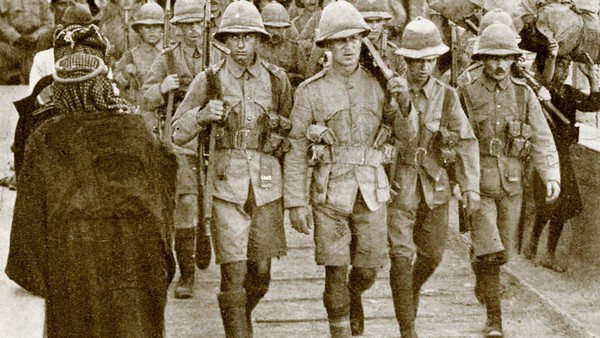
British troops march through a town in Mesopotamia en route to Baghdad, 1917
When
I was growing up in Lebanon, there were two or three designated
culprits for everything that went wrong, whether it was the latest
battle in the 1975-1990 civil war, a plunging currency or torrential
rains.
One was Henry Kissinger, even when he was no
longer involved in American foreign policy. Another was the Central
Intelligence Agency, preferred master of all conspiracies. The third
was Sykes-Picot, which to a child sounded more like the name of a cheese
than the 1916 secret agreement that drew the borders of the modern
Middle East in the waning days of the Ottoman Empire.
Mr Kissinger is still closely read today,
his words dissected and his arguments discussed. The CIA is still a
target of widespread resentment and, quite probably, involved in all
sorts of Middle Eastern shenanigans. But as sectarian fires blaze
through the nation states of the Arab world, the focus of blame has
shifted towards the conservative British politician and the young French
diplomat who carved the region into spheres of influence.
This week it is a century since Sir Mark
Sykes and François Georges-Picot drew that “line in the sand”. It is,
therefore, an opportune time for more fervent debate.
It is an enduring and unfortunate habit in
the Arab world to blame outsiders for the ruinous state of the region
and to see in every act the sinister hand of foreign conspirators. The
alternative — the idea that maybe the Middle East has been ruined by its
own people and its leaders — is an inconvenient truth.
But it’s not just Arabs who blame
Sykes-Picot. Many commentators and politicians from elsewhere look to
colonialism and the artificial drawing of national boundaries as the
source of the calamitous present. The argument is expedient because of
its simplicity, its ability to make the concept of partition more
palatable and for sheltering from blame misguided recent policies — the
2003 Iraq war, say, or the lack of action to halt the civil war in
Syria.
It is largely thanks to Isis that the debate
over Sykes-Picot has resurfaced. The group staged a brilliant stunt
when, after capturing swaths of Iraqi and Syrian territory in 2014, its
jihadis demolished a sand berm, or barrier, on the border and declared
the death of Sykes-Picot. Isis leaders knew the symbolism would elicit
attention, if not cheers, even from those who despised the group.
Indeed, the act unleashed a torrent of commentary proclaiming the
official death of the British-French design. For some, the conclusion
was good riddance.
The Middle East is evidently disintegrating. Iraq has
been lurching towards de facto partition between Shia, Sunni and
Kurdish mini-states; Syria’s civil war has divided communities along
ethnic lines; and other states (Lebanon at the top of the list) are
shuddering under the burden of millions of Syrian refugees.
But pinning blame for the Middle East
cauldron on a plan hatched decades ago is misleading. For all the damage
that colonialism has inflicted on the region, the borders are not
responsible for the states’ failures to unite the people behind a
national project. Many other countries outside the region have
artificial boundaries too and, in any case, the broad lines drawn by
Sykes and Picot were not dreamt up — often they largely corresponded to
Ottoman administrative borders.
When Arab youth rose up in revolt in 2011,
their slogan was not “the people want the fall of Sykes-Picot”; it was
“the people want the fall of the regime”. If ethnic and religious
identity now trumps national attachment in many parts of the Middle
East, that is the result of collective disenchantment and insecurity,
not a harking back to some fictitious past.
Apart from the Kurds who aspire to
an independent state, partition on religious lines is not the people’s
ambition. Whether at the birth of the new states or today, as some
appear to disintegrate, aspirations remain the same: people want to live
in dignity, governed by responsible and accountable governments. In
Syria, Iraq or Lebanon, civil society, when it still agitates, rallies
against economic mismanagement and a corrupt political class. On this
100th anniversary of Sykes-Picot, it is time to let go of its ghost.

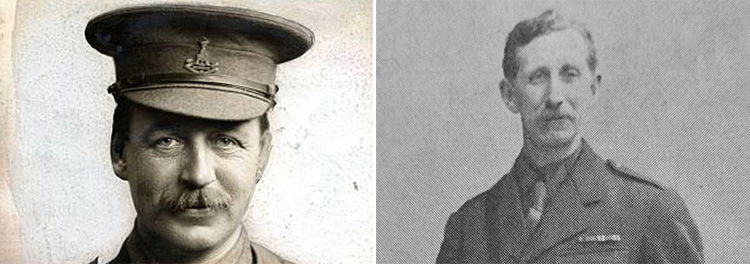 Mark Sykes (left) and François Georges-Picot
 ___________