Gaza 2009
1. Former Amb. Martin Indyk vs. Author Norman Finkelstein: A Debate on Israel’s Assault on Gaza and the US Role in the Conflict: Listen to or read the debate moderated by Amy Goodman on Democracy Now TV and Radio here.
2. How Israel brought Gaza to the brink of humanitarian catastrophe
By Avi Shlaim
The Guardian, Wednesday 7 January 2009
Oxford professor of international relations Avi Shlaim served in the Israeli army and has never questioned the state's legitimacy. But its merciless assault on Gaza has led him to devastating conclusions
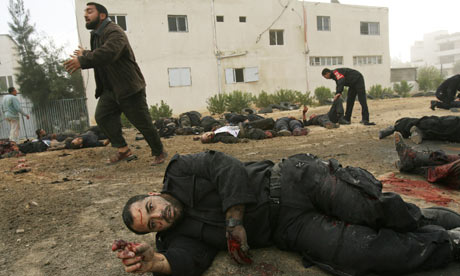
A wounded Palestinian policeman gestures while lying on the ground outside Hamas police headquarters following an Israeli air strike in Gaza City. Photograph: Mohammed Abed/AFP/Getty Images
The only way to make sense of Israel's senseless war in Gaza is through understanding the historical context. Establishing the state of Israel in May 1948 involved a monumental injustice to the Palestinians. British officials bitterly resented American partisanship on behalf of the infant state. On 2 June 1948, Sir John Troutbeck wrote to the foreign secretary, Ernest Bevin, that the Americans were responsible for the creation of a gangster state headed by "an utterly unscrupulous set of leaders". I used to think that this judgment was too harsh but Israel's vicious assault on the people of Gaza, and the Bush administration's complicity in this assault, have reopened the question.
I write as someone who served loyally in the Israeli army in the mid-1960s and who has never questioned the legitimacy of the state of Israel within its pre-1967 borders. What I utterly reject is the Zionist colonial project beyond the Green Line. The Israeli occupation of the West Bank and the Gaza Strip in the aftermath of the June 1967 war had very little to do with security and everything to do with territorial expansionism. The aim was to establish Greater Israel through permanent political, economic and military control over the Palestinian territories. And the result has been one of the most prolonged and brutal military occupations of modern times.
Four decades of Israeli control did incalculable damage to the economy of the Gaza Strip. With a large population of 1948 refugees crammed into a tiny strip of land, with no infrastructure or natural resources, Gaza's prospects were never bright. Gaza, however, is not simply a case of economic under-development but a uniquely cruel case of deliberate de-development. To use the Biblical phrase, Israel turned the people of Gaza into the hewers of wood and the drawers of water, into a source of cheap labour and a captive market for Israeli goods. The development of local industry was actively impeded so as to make it impossible for the Palestinians to end their subordination to Israel and to establish the economic underpinnings essential for real political independence.
Gaza is a classic case of colonial exploitation in the post-colonial era. Jewish settlements in occupied territories are immoral, illegal and an insurmountable obstacle to peace. They are at once the instrument of exploitation and the symbol of the hated occupation. In Gaza, the Jewish settlers numbered only 8,000 in 2005 compared with 1.4 million local residents. Yet the settlers controlled 25% of the territory, 40% of the arable land and the lion's share of the scarce water resources. Cheek by jowl with these foreign intruders, the majority of the local population lived in abject poverty and unimaginable misery. Eighty per cent of them still subsist on less than $2 a day. The living conditions in the strip remain an affront to civilised values, a powerful precipitant to resistance and a fertile breeding ground for political extremism.
In August 2005 a Likud government headed by Ariel Sharon staged a unilateral Israeli pullout from Gaza, withdrawing all 8,000 settlers and destroying the houses and farms they had left behind. Hamas, the Islamic resistance movement, conducted an effective campaign to drive the Israelis out of Gaza. The withdrawal was a humiliation for the Israeli Defence Forces. To the world, Sharon presented the withdrawal from Gaza as a contribution to peace based on a two-state solution. But in the year after, another 12,000 Israelis settled on the West Bank, further reducing the scope for an independent Palestinian state. Land-grabbing and peace-making are simply incompatible. Israel had a choice and it chose land over peace.
The real purpose behind the move was to redraw unilaterally the borders of Greater Israel by incorporating the main settlement blocs on the West Bank to the state of Israel. Withdrawal from Gaza was thus not a prelude to a peace deal with the Palestinian Authority but a prelude to further Zionist expansion on the West Bank. It was a unilateral Israeli move undertaken in what was seen, mistakenly in my view, as an Israeli national interest. Anchored in a fundamental rejection of the Palestinian national identity, the withdrawal from Gaza was part of a long-term effort to deny the Palestinian people any independent political existence on their land.
Israel's settlers were withdrawn but Israeli soldiers continued to control all access to the Gaza Strip by land, sea and air. Gaza was converted overnight into an open-air prison. From this point on, the Israeli air force enjoyed unrestricted freedom to drop bombs, to make sonic booms by flying low and breaking the sound barrier, and to terrorise the hapless inhabitants of this prison.
Israel likes to portray itself as an island of democracy in a sea of authoritarianism. Yet Israel has never in its entire history done anything to promote democracy on the Arab side and has done a great deal to undermine it. Israel has a long history of secret collaboration with reactionary Arab regimes to suppress Palestinian nationalism. Despite all the handicaps, the Palestinian people succeeded in building the only genuine democracy in the Arab world with the possible exception of Lebanon. In January 2006, free and fair elections for the Legislative Council of the Palestinian Authority brought to power a Hamas-led government. Israel, however, refused to recognise the democratically elected government, claiming that Hamas is purely and simply a terrorist organisation.
America and the EU shamelessly joined Israel in ostracising and demonising the Hamas government and in trying to bring it down by withholding tax revenues and foreign aid. A surreal situation thus developed with a significant part of the international community imposing economic sanctions not against the occupier but against the occupied, not against the oppressor but against the oppressed.
As so often in the tragic history of Palestine, the victims were blamed for their own misfortunes. Israel's propaganda machine persistently purveyed the notion that the Palestinians are terrorists, that they reject coexistence with the Jewish state, that their nationalism is little more than antisemitism, that Hamas is just a bunch of religious fanatics and that Islam is incompatible with democracy. But the simple truth is that the Palestinian people are a normal people with normal aspirations. They are no better but they are no worse than any other national group. What they aspire to, above all, is a piece of land to call their own on which to live in freedom and dignity.
Like other radical movements, Hamas began to moderate its political programme following its rise to power. From the ideological rejectionism of its charter, it began to move towards pragmatic accommodation of a two-state solution. In March 2007, Hamas and Fatah formed a national unity government that was ready to negotiate a long-term ceasefire with Israel. Israel, however, refused to negotiate with a government that included Hamas.
It continued to play the old game of divide and rule between rival Palestinian factions. In the late 1980s, Israel had supported the nascent Hamas in order to weaken Fatah, the secular nationalist movement led by Yasser Arafat. Now Israel began to encourage the corrupt and pliant Fatah leaders to overthrow their religious political rivals and recapture power. Aggressive American neoconservatives participated in the sinister plot to instigate a Palestinian civil war. Their meddling was a major factor in the collapse of the national unity government and in driving Hamas to seize power in Gaza in June 2007 to pre-empt a Fatah coup.
The war unleashed by Israel on Gaza on 27 December was the culmination of a series of clashes and confrontations with the Hamas government. In a broader sense, however, it is a war between Israel and the Palestinian people, because the people had elected the party to power. The declared aim of the war is to weaken Hamas and to intensify the pressure until its leaders agree to a new ceasefire on Israel's terms. The undeclared aim is to ensure that the Palestinians in Gaza are seen by the world simply as a humanitarian problem and thus to derail their struggle for independence and statehood.
The timing of the war was determined by political expediency. A general election is scheduled for 10 February and, in the lead-up to the election, all the main contenders are looking for an opportunity to prove their toughness. The army top brass had been champing at the bit to deliver a crushing blow to Hamas in order to remove the stain left on their reputation by the failure of the war against Hezbollah in Lebanon in July 2006. Israel's cynical leaders could also count on apathy and impotence of the pro-western Arab regimes and on blind support from President Bush in the twilight of his term in the White House. Bush readily obliged by putting all the blame for the crisis on Hamas, vetoing proposals at the UN Security Council for an immediate ceasefire and issuing Israel with a free pass to mount a ground invasion of Gaza.
As always, mighty Israel claims to be the victim of Palestinian aggression but the sheer asymmetry of power between the two sides leaves little room for doubt as to who is the real victim. This is indeed a conflict between David and Goliath but the Biblical image has been inverted - a small and defenceless Palestinian David faces a heavily armed, merciless and overbearing Israeli Goliath. The resort to brute military force is accompanied, as always, by the shrill rhetoric of victimhood and a farrago of self-pity overlaid with self-righteousness. In Hebrew this is known as the syndrome of bokhim ve-yorim, "crying and shooting".
To be sure, Hamas is not an entirely innocent party in this conflict. Denied the fruit of its electoral victory and confronted with an unscrupulous adversary, it has resorted to the weapon of the weak - terror. Militants from Hamas and Islamic Jihad kept launching Qassam rocket attacks against Israeli settlements near the border with Gaza until Egypt brokered a six-month ceasefire last June. The damage caused by these primitive rockets is minimal but the psychological impact is immense, prompting the public to demand protection from its government. Under the circumstances, Israel had the right to act in self-defence but its response to the pinpricks of rocket attacks was totally disproportionate. The figures speak for themselves. In the three years after the withdrawal from Gaza, 11 Israelis were killed by rocket fire. On the other hand, in 2005-7 alone, the IDF killed 1,290 Palestinians in Gaza, including 222 children.
Whatever the numbers, killing civilians is wrong. This rule applies to Israel as much as it does to Hamas, but Israel's entire record is one of unbridled and unremitting brutality towards the inhabitants of Gaza. Israel also maintained the blockade of Gaza after the ceasefire came into force which, in the view of the Hamas leaders, amounted to a violation of the agreement. During the ceasefire, Israel prevented any exports from leaving the strip in clear violation of a 2005 accord, leading to a sharp drop in employment opportunities. Officially, 49.1% of the population is unemployed. At the same time, Israel restricted drastically the number of trucks carrying food, fuel, cooking-gas canisters, spare parts for water and sanitation plants, and medical supplies to Gaza. It is difficult to see how starving and freezing the civilians of Gaza could protect the people on the Israeli side of the border. But even if it did, it would still be immoral, a form of collective punishment that is strictly forbidden by international humanitarian law.
The brutality of Israel's soldiers is fully matched by the mendacity of its spokesmen. Eight months before launching the current war on Gaza, Israel established a National Information Directorate. The core messages of this directorate to the media are that Hamas broke the ceasefire agreements; that Israel's objective is the defence of its population; and that Israel's forces are taking the utmost care not to hurt innocent civilians. Israel's spin doctors have been remarkably successful in getting this message across. But, in essence, their propaganda is a pack of lies.
A wide gap separates the reality of Israel's actions from the rhetoric of its spokesmen. It was not Hamas but the IDF that broke the ceasefire. It di d so by a raid into Gaza on 4 November that killed six Hamas men. Israel's objective is not just the defence of its population but the eventual overthrow of the Hamas government in Gaza by turning the people against their rulers. And far from taking care to spare civilians, Israel is guilty of indiscriminate bombing and of a three-year-old blockade that has brought the inhabitants of Gaza, now 1.5 million, to the brink of a humanitarian catastrophe.
The Biblical injunction of an eye for an eye is savage enough. But Israel's insane offensive against Gaza seems to follow the logic of an eye for an eyelash. After eight days of bombing, with a death toll of more than 400 Palestinians and four Israelis, the gung-ho cabinet ordered a land invasion of Gaza the consequences of which are incalculable.
No amount of military escalation can buy Israel immunity from rocket attacks from the military wing of Hamas. Despite all the death and destruction that Israel has inflicted on them, they kept up their resistance and they kept firing their rockets. This is a movement that glorifies victimhood and martyrdom. There is simply no military solution to the conflict between the two communities. The problem with Israel's concept of security is that it denies even the most elementary security to the other community. The only way for Israel to achieve security is not through shooting but through talks with Hamas, which has repeatedly declared its readiness to negotiate a long-term ceasefire with the Jewish state within its pre-1967 borders for 20, 30, or even 50 years. Israel has rejected this offer for the same reason it spurned the Arab League peace plan of 2002, which is still on the table: it involves concessions and compromises.
This brief review of Israel's record over the past four decades makes it difficult to resist the conclusion that it has become a rogue state with "an utterly unscrupulous set of leaders". A rogue state habitually violates international law, possesses weapons of mass destruction and practises terrorism - the use of violence against civilians for political purposes. Israel fulfils all of these three criteria; the cap fits and it must wear it. Israel's real aim is not peaceful coexistence with its Palestinian neighbours but military domination. It keeps compounding the mistakes of the past with new and more disastrous ones. Politicians, like everyone else, are of course free to repeat the lies and mistakes of the past. But it is not mandatory to do so.
• Avi Shlaim is a professor of international relations at the University of Oxford and the author of The Iron Wall: Israel and the Arab World and of Lion of Jordan: King Hussein's Life in War and Peace.
3. Why Israel Feels Threatened
By BENNY MORRIS
Li-On, Israel
MANY Israelis feel that the walls — and history — are closing in on their 60-year-old state, much as they felt in early June 1967, just before Israel launched the Six-Day War and destroyed the Egyptian, Jordanian and Syrian armies in Sinai, the West Bank and the Golan Heights.
More than 40 years ago, the Egyptians had driven a United Nations peacekeeping force from the Sinai-Israel border, had closed the Straits of Tiran to Israeli shipping and air traffic and had deployed the equivalent of seven armored and infantry divisions on Israel’s doorstep. Egypt had signed a series of military pacts with Syria and Jordan and placed troops in the West Bank. Arab radio stations blared messages about the coming destruction of Israel.
Israelis, or rather, Israeli Jews, are beginning to feel much the way their parents did in those apocalyptic days. Israel is a much more powerful and prosperous state today. In 1967 there were only some 2 million Jews in the country — today there are about 5.5 million — and the military did not have nuclear weapons. But the bulk of the population looks to the future with deep foreboding.
The foreboding has two general sources and four specific causes. The general problems are simple. First, the Arab and wider Islamic worlds, despite Israeli hopes since 1948 and notwithstanding the peace treaties signed by Egypt and Jordan in 1979 and 1994, have never truly accepted the legitimacy of Israel’s creation and continue to oppose its existence.
Second, public opinion in the West (and in democracies, governments can’t be far behind) is gradually reducing its support for Israel as the West looks askance at the Jewish state’s treatment of its Palestinian neighbors and wards. The Holocaust is increasingly becoming a faint and ineffectual memory and the Arab states are increasingly powerful and assertive.
More specifically, Israel faces a combination of dire threats. To the east, Iran is frantically advancing its nuclear project, which most Israelis and most of the world’s intelligence agencies believe is designed to produce nuclear weapons. This, coupled with Iranian President Mahmoud Ahmedinejad’s public threats to destroy Israel — and his denials of the Holocaust and of any homosexuality in Iran, which underscore his irrationality — has Israel’s political and military leaders on tenterhooks.
To the north, the Lebanese fundamentalist organization Hezbollah, which also vows to destroy Israel and functions as an Iranian proxy, has thoroughly rearmed since its war with Israel in 2006. According to Israeli intelligence estimates, Hezbollah now has an arsenal of 30,000 to 40,000 Russian-made rockets, supplied by Syria and Iran — twice the number it possessed in 2006. Some of the rockets can reach Tel Aviv and Dimona, where Israel’s nuclear production facility is located. If there is war between Israel and Iran, Hezbollah can be expected to join in. (It may well join in the renewed Israeli-Palestinian conflict, too.)
To the south, Israel faces the Islamist Hamas movement, which controls the Gaza Strip and whose charter promises to destroy Israel and bring every inch of Palestine under Islamic rule and law. Hamas today has an army of thousands. It also has a large arsenal of rockets — home-made Qassams and Russian-made, Iranian-financed Katyushas and Grads smuggled, with the Egyptians largely turning a blind eye, through tunnels from Sinai.
Last June, Israel and Hamas agreed to a six-month truce. This unsteady calm was periodically violated by armed factions in Gaza that lobbed rockets into Israel’s border settlements. Israel responded by periodically suspending shipments of supplies into Gaza.
In November and early December, Hamas stepped up the rocket attacks and then, unilaterally, formally announced the end of the truce. The Israeli public and government then gave Defense Minister Ehud Barak a free hand. Israel’s highly efficient air assault on Hamas, which began on Saturday, was his first move. Most of Hamas’s security and governmental compounds were turned into rubble and several hundred Hamas fighters were killed.
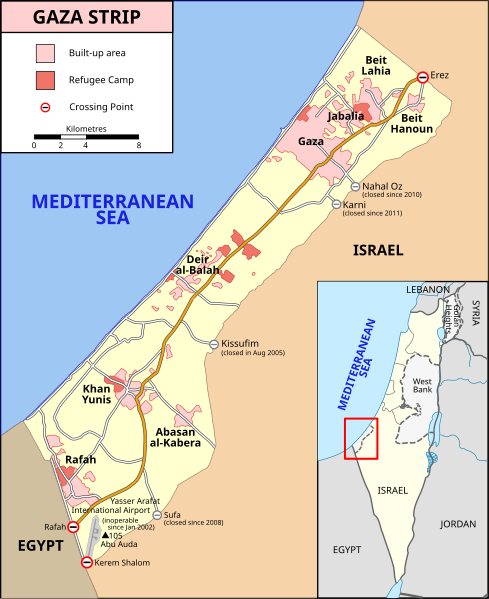
But the attack will not solve the basic problem posed by a Gaza Strip populated by 1.5 million impoverished, desperate Palestinians who are ruled by a fanatic regime and are tightly hemmed in by fences and by border crossings controlled by Israel and Egypt.
An enormous Israeli ground operation aimed at conquering the Gaza Strip and destroying Hamas would probably bog down in the alleyways of refugee camps before achieving its goal. (And even if these goals were somehow achieved, renewed and indefinite Israeli rule over Gaza would prove unpalatable to all concerned.)
More likely are small, limited armored incursions, intended to curtail missile launches and kill Hamas fighters. But these are also unlikely to bring the organization to heel — though they may exercise sufficient pressure eventually to achieve, with the mediation of Turkey or Egypt, a renewed temporary truce. That seems to be the most that can be hoped for, though a renewal of rocket attacks on southern Israel, once Hamas recovers, is as certain as day follows night.
The fourth immediate threat to Israel’s existence is internal. It is posed by the country’s Arab minority. Over the past two decades, Israel’s 1.3 million Arab citizens have been radicalized, with many openly avowing a Palestinian identity and embracing Palestinian national aims. Their spokesmen say that their loyalty lies with their people rather than with their state, Israel. Many of the community’s leaders, who benefit from Israeli democracy, more or less publicly supported Hezbollah in 2006 and continue to call for “autonomy” (of one sort or another) and for the dissolution of the Jewish state.
Demography, if not Arab victory in battle, offers the recipe for such a dissolution. The birth rates for Israeli Arabs are among the highest in the world, with 4 or 5 children per family (as opposed to the 2 or 3 children per family among Israeli Jews).
If present trends persist, Arabs could constitute the majority of Israel’s citizens by 2040 or 2050. Already, within five to 10 years, Palestinians (Israeli Arabs coupled with those who live in the West Bank and Gaza Strip) will form the majority population of Palestine (the land lying between the Jordan River and the Mediterranean).
Friction between Israeli Arabs and Jews is already a cogent political factor. In 2000, at the start of the second intifada, thousands of Arab youngsters, in sympathy with their brethren in the territories, rioted along Israel’s major highways and in Israel’s ethnically mixed cities.
The past fortnight has seen a recurrence, albeit on a smaller scale, of such rioting. Down the road, Israel’s Jews fear more violence and terrorism by Israeli Arabs. Most Jews see the Arab minority as a potential fifth column.
What is common to these specific threats is their unconventionality. Between 1948 and 1982 Israel coped relatively well with the threat from conventional Arab armies. Indeed, it repeatedly trounced them. But Iran’s nuclear threat, the rise of organizations like Hamas and Hezbollah that operate from across international borders and from the midst of dense civilian populations, and Israeli Arabs’ growing disaffection with the state and their identification with its enemies, offer a completely different set of challenges. And they are challenges that Israel’s leaders and public, bound by Western democratic and liberal norms of behavior, appear to find particularly difficult to counter.
Israel’s sense of the walls closing in on it has this past week led to one violent reaction. Given the new realities, it would not be surprising if more powerful explosions were to follow.
Benny Morris, a professor of Middle Eastern history at Ben-Gurion University, is the author, most recently, of “1948: A History of the First Arab-Israeli War.”
-----
4. An inside story of how the US magnified Palestinian suffering
By Norman H. Olsen and Matthew N. Olsen from the January 12, 2009 edition of the Christian Science Monitor
The covert push to empower Fatah failed. And isolating Hamas just made thingsworse. But it's not too late to change course.
Cherryfield, Maine; and Washington - A million and a half Palestinians are learning the hard way that democracy isn't so good if you vote the wrong way. In 2006, they elected Hamas when the US and Israel wanted them to support the more-moderate Fatah. As a result, having long ago lost their homes and property, Gazans have endured three years of embargo, crippling shortages of food and basic necessities, and total economic collapse.
We spoke again Saturday with three of our longtime Gazan contacts. They and their families, all Fatah supporters, were in their eleventh day without electricity, running water, or heat. They are cowering in cold basements trying to protect their children from the storm of explosions that is filling Shifa hospital with amputees and the dead. Our friends in Israel are likewise living in fear.
The 850-plus dead Gazans, more than a dozen dead Israelis, and some 3,000 injured have since the end of the cease-fire become part of what Secretary of State Condoleezza Rice once called the birth pains of a new Middle East.
It didn't have to be this way. We could have talked instead of fought.
Hamas never called for the elections that put them in power. That was the brainstorm of Secretary Rice and her staff, who had apparently decided they could steer Palestinians into supporting the more-compliant Mahmoud Abbas (the current president of the Palestinian authority) and his Fatah Party through a marketing campaign that was to counter Hamas's growing popularity – all while ignoring continued Israeli settlement construction, land confiscation, and cantonization of the West Bank.
State Department staffers helped finance and supervise the Fatah campaign, down to the choice of backdrop color for the podium where Mr. Abbas was to proclaim victory. An adviser working for the United States Agency for International Development (USAID) explained to incredulous staffers at the Embassy in Tel Aviv how he would finance and direct elements of the campaign, leaving no US fingerprints. USAID teams, meanwhile, struggled to implement projects for which Abbas could claim credit. Once the covert political program cemented Fatah in place, the militia Washington was building for Fatah warlord-wannabee Mohammed Dahlan would destroy Hamas militarily.
Their collective confidence was unbounded. But the Palestinians didn't get the memo. Rice was reportedly blindsided when she heard the news of Hamas's victory during her 5 a.m. treadmill workout. But that did not prevent a swift response.
She immediately insisted that the Quartet (the US, European Union, United Nations, and Russia) ban all contact with Hamas and support Israel's economic blockade of Gaza. The results of her request were mixed, but Palestinian suffering manifestly intensified. The isolation was supposed to turn angry Palestinians against an ineffective Hamas. As if such blockades had not been tried before.
Simultaneously, the US military team expanded its efforts to build the Mohammed Dahlan-led militia. President Bush considered Dahlan "our guy." But Dahlan's thugs moved too soon. They roamed Gaza, demanding protection money from businesses and individuals, erecting checkpoints to extort bribes, terrorizing Dahlan's opponents within Fatah, and attacking Hamas members.
Finally, in mid-2007, faced with increasing chaos and the widely known implementation of a US-backed militia, Hamas – the lawfully elected government – struck first. They routed the Fatah gangs, securing control of the entire Gaza Strip, and established civil order.
Its efforts stymied, the US has for more than a year inflexibly backed Israel's embargo of Gaza and its collective punishment of the Strip's 1.5 million residents. The recent six-month cease-fire saw a near cessation of rocket fire into Israel and calm along the border, yet the economic siege was further tightened.
Gaza's economy has collapsed, and the population, displaced for decades from their farms and villages, relies ever more on food aid from Hamas and the UN. The US expresses shock that Gazans resort to using smuggling tunnels for survival rather than passively accepting the suffering inflicted by the embargo. What would we expect Americans to do in the same circumstances? With no easing of the blockade, the missile launches have increased in range and frequency, yielding massive Israeli response.
Our "good," US-supported Palestinians did not vanquish the "bad" Palestinians any more than Washington's Lebanese clients turned on Hezbollah, despite the suffering and death of the 2006 war with Israel. Abbas sits emasculated in Ramallah. The Israelis continue to build settlements while blaming Iran for their troubles, as though the Palestinians have no grievances of their own. And we are further than ever from peace.
Cultural differences aside, Gazans, like Americans, unite in adversity. Neither punishment, nor a cease-fire that extends the embargo will make them accept the loss of their property, 60 years of displacement, or life in squalid refugee camps.
Nor, as decades of experience have proved, will too-clever US manipulation make Palestinians pliable to US and Israeli wishes. US financial and military support for Israel can maintain the status quo indefinitely, if that's what we want, but it cannot resolve fundamental issues or bring peace. For that, we need to talk, even if at arm's length initially, and not leave the hard issues to the end. That only leaves the radicals on both sides the opportunity to undermine peace efforts and extend the senseless loss of life. Until we talk about real issues, both Palestinians and Israelis will be cowering in cellars.
Such dialogue won't be easy, but with concerted US-led effort, it is within reach. A significant portion of the provisions that will constitute a comprehensive agreement, even on the most difficult issues, have already been put together by discreet, experienced Track2 negotiators.
The difficulty lies in the politics of giving concessions and selling them to the public. Only the US has the influence to move the parties past their weaknesses with a comprehensive regional initiative, thereby defusing those who argue against concessions for any bilateral peace agreement while other enemies remain.
That's why President-elect Obama must reconsider his plan to appoint a traditional Washington-based Middle East envoy, reportedly former envoy Dennis Ross, and instead pursue a course that signals change. He should:
•Declare his determination to pursue from his first day in office, not the final six months, full peace between Israel and all its neighbors. Only by doing so can he win support among Israelis, Palestinians, the Congress, and the international partners we'll need to support this historic effort.
•Name an outstanding peace envoy to be resident full time in the region with authority over our missions in Tel Aviv and Jerusalem. He or she must have the presidential backing and stamina to withstand the pressures and pitfalls of a comprehensive peace process over the long haul. In addition, this envoy must have authority over all US interactions with the Palestinians and Israelis and later, with other parties, reporting directly to the president in collaboration with the National Security Adviser and secretary of State. Assisted with staff comprising the US government's foremost experts, this envoy would be the single US voice on this issue.
•Empower the envoy to engage with all parties to the conflict, regardless of current prohibitions, on all issues, overturning long-established policy.
•Fund a political and economic development process second only to those in Iraq and Afghanistan.
Only by an "all out" effort can we hope to convince all the parties, and a skeptical international community, that the US is determined to achieve peace and prosperity for all the peoples of the region.
• Norman H. Olsen served for 26 years as a member of the US Foreign Service, including four years working in the Gaza Strip and four years as counselor for political affairs at the US Embassy in Tel Aviv. He was most recently associate coordinator for counterterrorism at the Department of State. His son, Matthew N. Olsen, is the director of Explore Corps, a nascent NGO that uses outdoor education and youth programming to facilitate peace-building among young adults, with several current projects in the Gaza Strip.
5. This brutality will never break our will to be free
For six months we in Hamas observed the ceasefire. Israel broke it repeatedly.
The Guardian, Tuesday 6 January 2009
For 18 months my people in Gaza have been under siege, incarcerated inside the world's biggest prison, sealed off from land, air and sea, caged and starved, denied even medication for our sick. After the slow death policy came the bombardment. In this most densely populated of places, nothing has been spared Israel's warplanes, from government buildings to homes, mosques, hospitals, schools and markets. More than 540 have been killed and thousands permanently maimed. A third are women and children. Whole families have been massacred, some while they slept.
This river of blood is being shed under lies and false pretexts. For six months we in Hamas observed the ceasefire. Israel broke it repeatedly from the start. Israel was required to open crossings to Gaza, and extend the truce to the West Bank. It proceeded to tighten its deadly siege of Gaza, repeatedly cutting electricity and water supplies. The collective punishment did not halt, but accelerated - as did the assassinations and killings. Thirty Gazans were killed by Israeli fire and hundreds of patients died as a direct effect of the siege during the so-called ceasefire. Israel enjoyed a period of calm. Our people did not.
When this broken truce neared its end, we expressed our readiness for a new comprehensive truce in return for lifting the blockade and opening all Gaza border crossings, including Rafah. Our calls fell on deaf ears. Yet still we would be willing to begin a new truce on these terms following the complete withdrawal of the invading forces from Gaza.
No rockets have ever been fired from the West Bank. But 50 died and hundreds more were injured there last year at Israel's hands, while its expansionism proceeded relentlessly. We are meant to be content with shrinking scraps of territory, a handful of cantons at Israel's mercy, enclosed by it from all sides.The truth is Israel seeks a one-sided ceasefire, observed by my people alone, in return for siege, starvation, bombardment, assassinations, incursions and colonial settlement. What Israel wants is a gratuitous ceasefire.
The logic of those who demand that we stop our resistance is absurd. They absolve the aggressor and occupier - armed with the deadliest weapons of death and destruction - of responsibility, while blaming the victim, prisoner and occupied. Our modest, home-made rockets are our cry of protest to the world. Israel and its American and European sponsors want us to be killed in silence. But die in silence we will not.
What is being visited on Gaza today was visited on Yasser Arafat before. When he refused to bow to Israel's dictates, he was imprisoned in his Ramallah headquarters, surrounded by tanks for two years. When this failed to break his resolve, he was murdered by poisoning.
Gaza enters 2009 just as it did 2008: under Israeli fire. Between January and February of last year 140 Gazans died in air strikes. And just before it embarked on its failed military assault on Lebanon in July 2006, Israel rained thousands of shells on Gaza, killing 240. From Deir Yassin in 1948 to Gaza today, the list of Israel's crimes is long. The justifications change, but the reality is the same: colonial occupation, oppression, and never-ending injustice. If this is the "free world" whose "values" Israel is defending, as its foreign minister Tzipi Livni alleges, then we want nothing to do with it.
Israel's leaders remain in the grip of confusion, unable to set clear goals for the attacks - from ousting the legitimately elected Hamas government and destroying its infrastructure, to stopping the rockets. As they fail to break Gaza's resistance the benchmark has been lowered. Now they speak of weakening Hamas and limiting the resistance. But they will achieve neither. Gaza's people are more united than ever, determined not to be terrorised into submission. Our fighters, armed with the justice of their cause, have already caused many casualties among the occupation army and will fight on to defend their land and people. Nothing can defeat our will to be free.
Once again, Washington and Europe have opted to aid and abet the jailer, occupier and aggressor, and to condemn its victims. We hoped Barack Obama would break with George Bush's disastrous legacy but his start is not encouraging. While he swiftly moved to denounce the Mumbai attacks, he remains tongue-tied after 10 days of slaughter in Gaza. But my people are not alone. Millions of freedom-loving men and women stand by its struggle for justice and liberation - witness daily protests against Israeli aggression, not only in the Arab and Islamic region, but worldwide.
Israel will no doubt wreak untold destruction, death and suffering in Gaza. But it will meet the same fate in Gaza as it did in Lebanon. We will not be broken by siege and bombardment, and will never surrender to occupation.
• Khalid Mish'al is the head of the Hamas political bureau
-----
6. 'Israel Is Not Going to Show Restraint'
Lally Weymouth
Saturday, January 10, 2009; A13
Israeli Foreign Minister Tzipi Livni told Newsweek-The Post's Lally Weymouth that the conflict in Gaza is not a fight of Israelis against Palestinians but a case in which Israel represents moderates in the region, including the Palestinian Authority. Excerpts:
Q. How do you respond to the pressure for a cease-fire from the international community?
A. I don't like the term cease-fire since it looks like an agreement between two legitimate sides. At the end of the day, this is not a conflict between two states but a fight against terror. . . . We need to fight in Gaza because they [Hamas] have targeted Israel for eight years. We are fighting in order to weaken them and to affect their ability to target Israel in the future.
To do that, don't you need the Egyptians to exert tighter control over the border crossing?
Yes, there are three parameters. One is missiles coming from Iran. The other is Egypt itself, and the third is the border between the Gaza Strip and Egypt.
Is the idea that Egypt will now take a more active role in stopping the smuggling?
This must be stopped by Israel or someone else. In six months, Hamas has changed the range of the missiles from 20 kilometers to 50 kilometers. This now threatens 1 million Israelis. We used to say it was just the southern part of Israel but . . . now parts in the center of Israel are under threat. We needed to give an answer to their rearmament. . . .
We need to know that at the end of this military operation, we will not face the rearmament of Hamas.
Is Iran behind it all?
Oh, yes, clearly. We know that. When they started, the missiles were homemade -- made in the Gaza Strip. But not anymore. Now they are professional, coming from Iran.
How long do you think this operation is going to take?
It depends. First we need to find out whether they understand that Israel is no longer a state which they can target while hoping for restraint. Israel is going to defend itself.
Have you achieved your objectives?
I think that some of these goals were achieved. . . . At first they were shocked by the air raids. Then they thought Israel would never enter the Gaza Strip in a ground operation. So I think this is the point in which they understand the equation has changed and we have gained deterrence.
Will Israel reoccupy Gaza?
The idea is not to reoccupy the Gaza Strip. When we left the Gaza Strip, Hamas used to write on billboards that terror won and Israel left Gaza because of terror. So today the message for the Palestinians is that we left the Gaza Strip in order to create hopes for peace. But now we are coming back because of terror.
It must have been a difficult decision to send Israeli troops into Gaza by land?
Yes, it was a very difficult decision, but right now it looks good.
Are you worried that Hamas will claim victory as [Hezbollah leader] Hassan Nasrallah did in Lebanon?
Even Nasrallah said after the war in Lebanon that if he had known that this was what we were going to do. . . . I think that most of them have the same feeling after a few days of war.
Are you thinking about stopping?
On a daily basis. We are not looking to reoccupy the Gaza Strip. But we need to see that we achieved our goals.
Do you think the fighting will be over by the time that President-elect Obama is inaugurated?
The shortest period of fighting is better for us. But at the end of the day, it is an ongoing war against terror. We don't ask the international community to fight with us. We ask the international community to give us some understanding and time.
Does the pressure put on Israel by the international community to reach a cease-fire strengthen the hand of Hamas?
Hamas's strategy is resistance and survival. As long as they survive, this is a victory. When they know the international community is putting pressure on Israel, they can hold out and take some oxygen, waiting for Israel to be stopped by the international community. It is a pity.
Are you still in favor of an international monitoring group to help control the borders of Gaza -- especially its border with Egypt?
I am not against the participation of the international community, but it doesn't replace our need to fight terrorism. And sometimes, when you have monitoring forces within a place, it makes it more difficult for us to defend ourselves, because the last thing we want is to kill people by mistake. . . .
Israel is not going to show restraint anymore. . . . it is not a missile against a missile. We are going to attack strongly if they continue.
Do you believe the Obama administration will support Israel the way Bush did?
I do believe that the United States and Israel share not only the same values and interests and the same understanding.
People in Washington are interested in how long the operation will last and what Israel's aim is.
The Annapolis process is based on the understanding that we are working with a pragmatic leadership in the Palestinian Authority while fighting terror. It is a zero-sum game when Hamas is getting stronger while Abu Mazen is getting weaker. The Palestinians need to understand that Israel can share and implement and translate the vision of two states for two peoples with those that accept this vision, who accept Israel's existence and renounce violence and terrorism. Hamas does not. Hamas does not represent the national aspirations of the Palestinians. It represents extreme Islamic ideas, which they share with Iran, Hezbollah and Syria.
Your goal is to continue the dialogue with the Palestinian Authority but also weaken the extremists?
Yes. . . . We are willing to . . . try and find a peace treaty with the moderates as long [as] at the end of the day, we don't fight a terror state on the other side of the border.
Would you say [Hamas] needs to be removed?
I would say that the Gaza Strip controlled by Hamas is a burden not only to Israel but to the Palestinians themselves.
Do you feel [you] have the backing of the Arab moderates?
I don't want to embarrass anybody, but I know I represent their interests as well. It is no longer the Israeli-Palestinian or the Jewish-Arab conflict, but it is a conflict between moderates and extremists. This is the way this region is now divided.
7. Israel bans Arab parties from running in upcoming elections
Haaretz, 13/01/2009, By Shahar Ilan and Roni Singer-Heruti,
Haaretz Correspondents and The Associated PressThe Central Elections Committee (CEC) yesterday banned the Arab parties United Arab List-Ta'al and Balad from running in next month's parliamentary elections amid accusations of racism from Arab MKs. Both parties intend to challenge the decision in the Supreme Court. Members of the CEC conceded yesterday that the chance of the Supreme Court's upholding the ban on both parties was slim.
Arab faction delegates in the CEC walked out of the hall before the vote, shouting, "this is a fascist, racist state." As they walked out, CEC deputy chairman MK David Tal (Kadima) and the Arab delegates pushed each other and a Knesset guard had to intervene and separate them.

